 OCS
By Bryden Basil C. Elizan, Founder, Online Creative Solutions · Jul 12, 2026 · 4 min read
Generating hotel inquiries is easy. Generating inquiries from travelers who are genuinely ready to book is much harder.
Many hotel campaigns produce impressive lead numbers, only to see potential guests disappear before reaching the booking engine. For one Baguio hotel, Online Creative Solutions (OCS) focused on solving exactly that problem.
Rather than optimizing solely for lead volume, we built a campaign designed to attract qualified travelers and guide them smoothly into the hotel’s reservation system.
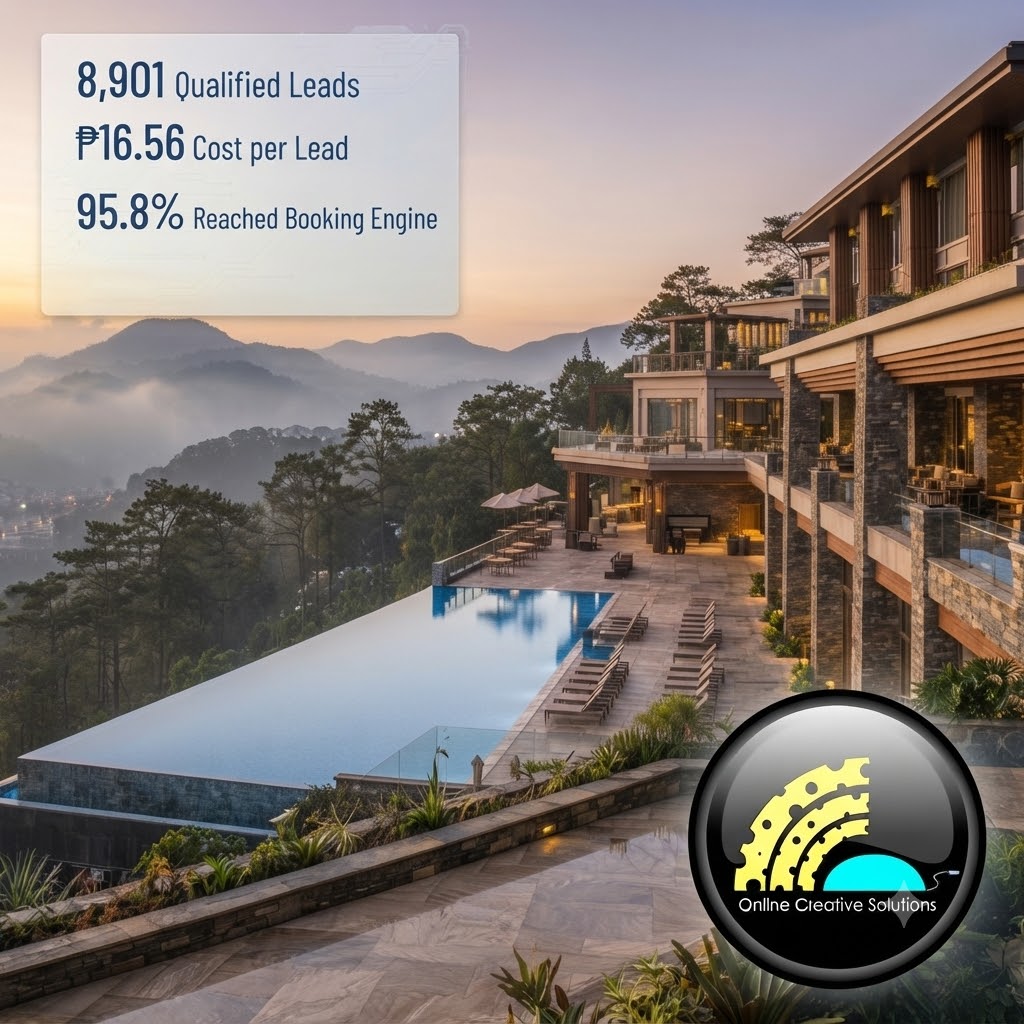
Online Creative Solutions developed a Meta Lead Generation campaign for a Baguio hotel that generated 8,901 qualified leads at an average cost per result of ₱16.56. Of those leads, 8,528 (95.8%) proceeded to the hotel’s external booking engine, creating a strong pipeline of high-intent travelers ready to continue the reservation process.
The Project
The client is a well-established hotel in Baguio City serving leisure travelers, families, and vacationers. Like many hotels in the Philippines, reservations are completed through a third-party booking engine rather than directly on the hotel’s website.
While this approach offers operational advantages, it also introduces additional friction into the booking journey. Every extra step increases the possibility that a potential guest abandons the reservation.
The objective wasn’t simply to generate leads. It was to move qualified travelers efficiently into the booking process.
The Challenge
Hotel marketing involves more than encouraging someone to click an advertisement. Successful campaigns must identify travelers who are genuinely interested in booking, and keep them engaged long enough to reach the booking engine.
Many campaigns succeed at the first step but lose momentum before the second. The result is a large number of leads with little impact on actual reservations. The challenge was to reduce that drop-off while maintaining an efficient acquisition cost.
What OCS Did
Rather than sending cold traffic directly to the hotel’s booking engine, OCS designed a campaign that gradually moved travelers through the reservation journey. Four improvements strengthened the funnel.
1. Capturing intent inside Meta
The campaign used Meta’s Lead Generation objective. Instead of immediately redirecting users to an external booking website, prospective guests first completed a lead form within Facebook or Instagram, which reduced initial friction.
2. Focusing on higher-intent travelers
Audience targeting emphasized users who demonstrated stronger travel intent rather than broad tourism interest, while excluding segments with historically lower engagement quality. The goal was to generate better leads, not just more.
3. Optimizing the lead experience
The lead form qualified interest before directing users toward the booking process. Clear messaging set expectations and discouraged casual or low-intent submissions.
4. Reducing friction after the form
Immediately after form completion, users received a clear call to action directing them to the hotel’s booking engine, preserving intent while it was strongest.
The Results
According to Meta Ads Manager:
- 8,901 qualified Meta leads
- ₱16.56 average cost per lead
- 8,528 booking-engine click-throughs
- 95.8% of leads continued into the booking process
Most users who completed the lead form also took the next important step: visiting the hotel’s booking engine. Final reservations and revenue are managed within the hotel’s booking platform and are outside the scope of this campaign’s directly attributable metrics.
Why This Worked
Many lead-generation campaigns focus almost entirely on acquiring the lowest-cost lead. OCS focused on what happened after the lead, reducing unnecessary friction at every stage:
- Higher-quality audience targeting
- Clear qualification messaging
- Simpler lead capture
- Immediate progression toward booking
The OCS Approach
We don’t measure campaign success solely by lead volume. We evaluate how effectively leads move through the entire customer journey. For hospitality businesses that means optimizing audience quality, lead acquisition, booking flow, campaign efficiency and ongoing performance.
Ready to generate more qualified hotel bookings?
If your hotel advertising produces inquiries that rarely become reservations, the problem may not be your budget. It may be the journey between the advertisement and your booking engine. Book a free discovery call and let’s strengthen your reservation funnel.
Frequently asked questions
Why use Meta Lead Ads instead of sending visitors directly to a booking engine?
Lead forms reduce the friction of the first conversion by allowing users to express interest without immediately leaving Facebook or Instagram. Once intent is established, they can be directed to the booking platform.
What makes a hotel lead “qualified”?
Qualified leads are travelers whose demographic, behavioral, and interest signals indicate a higher likelihood of booking compared to broader travel audiences.
Is ₱16.56 per lead considered efficient?
Lead costs vary by destination, competition, and campaign objectives. In this campaign the cost stayed efficient while also producing a high percentage of users who continued to the booking engine.
Why is post-lead routing important?
Capturing a lead is only the beginning. Reducing delays between lead submission and the booking engine helps maintain traveler intent and encourages more users to continue the reservation process.

Bryden Basil C. Elizan founded Online Creative Solutions and mentors for the DTI, DICT and Go Negosyo. OCS has served 100+ Philippine SMEs since 2007.