
By Bryden Basil C. Elizan, Founder, Online Creative Solutions
Ranking on the first page of Google is difficult.
Ranking beside one of the world’s largest travel websites is even harder.
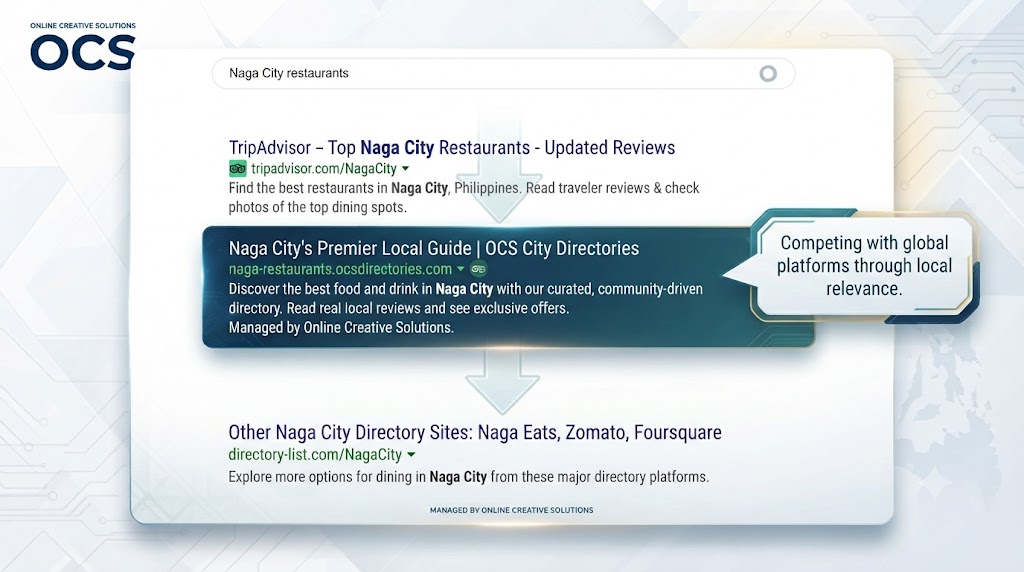
Yet through a focused local SEO strategy, an OCS-owned city directory achieved exactly that—earning the #2 organic position for the search term “Naga City restaurants,” directly below TripAdvisor.
The result wasn’t achieved through paid advertising or shortcuts.
It came from understanding how Google evaluates local relevance, topical authority, and search intent.
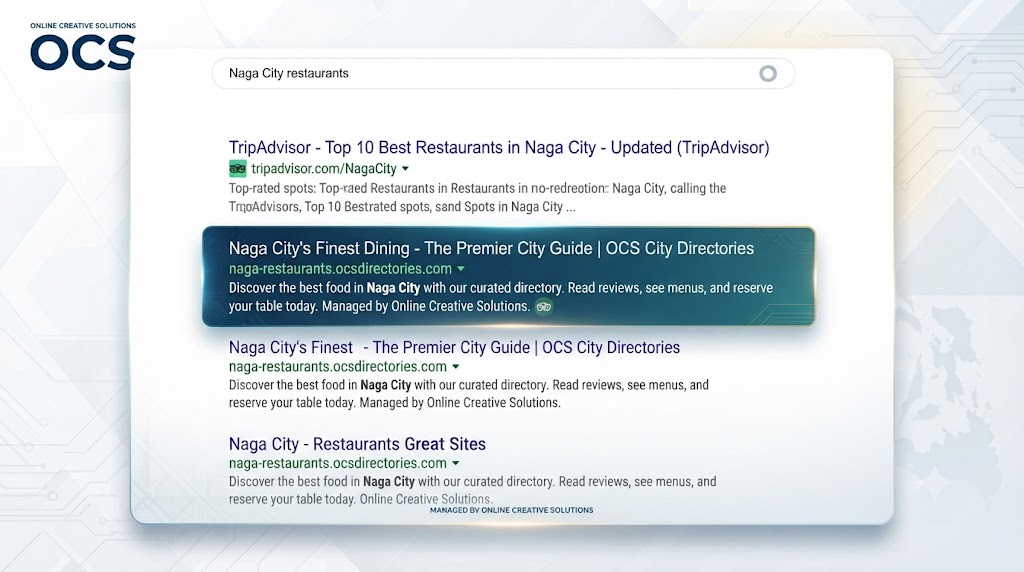
Online Creative Solutions helped an OCS-owned regional city directory rank #2 organically for the commercial search query “Naga City restaurants” by combining rigorous on-page SEO, semantic keyword clustering, and hyper-local content.
The result placed the directory directly beneath TripAdvisor in Google’s organic search results at the time of measurement.
The Project
This project involved one of our own digital properties.
The website is a regional city directory designed to help residents and visitors discover restaurants, hotels, attractions, and local businesses across Naga City and the Bicol Region.
Because it is independently operated, the directory competes against platforms with enormous advantages, including:
- TripAdvisor
- Google Maps
- Other large travel and review websites
These platforms have significantly stronger domain authority, millions of indexed pages, and years of accumulated search signals.
Our goal was straightforward:
Earn first-page visibility for one of the city’s most commercially valuable search queries.
The Challenge
The keyword “Naga City restaurants” carries strong commercial intent.
People searching for this phrase are typically ready to decide where to eat.
That makes the keyword valuable—and highly competitive.
Google’s search results are usually dominated by:
- TripAdvisor
- Google Maps
- Large travel platforms
- Food review websites
Independent local directories rarely appear near the top because they lack the authority enjoyed by global brands.
The challenge wasn’t simply ranking on page one.
It was competing against websites backed by decades of authority and millions of backlinks.
What OCS Did
Rather than trying to outmatch global websites in size, OCS focused on becoming the most locally relevant resource for the search query.
Three key strategies made the difference.
1. Strengthening Every On-Page SEO Signal
Every element of the target page was reviewed and optimized, including:
- Title tags
- Meta descriptions
- Heading hierarchy
- Internal links
- Keyword placement
- Page speed
- User experience
Instead of relying on default settings, each element was intentionally designed to reinforce the page’s relevance for users searching specifically for restaurants in Naga City.
2. Building Topical Authority Through Semantic Clustering
Google doesn’t evaluate pages in isolation.
It evaluates how well an entire website demonstrates expertise on a topic.
To strengthen topical authority, OCS created supporting content around related restaurant topics, including:
- Cuisine categories
- Dining occasions
- Neighborhood guides
- Local food recommendations
These supporting pages linked naturally back to the main restaurant directory, helping Google understand the broader subject expertise of the website.
3. Creating Truly Local Content
Many large directory websites rely on standardized templates that can feel generic.
OCS took a different approach.
Restaurant listings were enriched with information that only a local publisher could provide, including:
- Neighborhood references
- Nearby landmarks
- Bicolano cuisine highlights
- Local context for residents and visitors
These location-specific details helped the directory better satisfy the intent behind a geographically focused search.
The Results
Following the optimization work, the directory achieved a significant improvement in organic visibility.
At the time the rankings were recorded:
- The page ranked #2 organically for the search term “Naga City restaurants.”
- It appeared directly beneath TripAdvisor.
- The ranking was achieved through organic SEO without paid search advertising.
Search rankings naturally fluctuate over time as Google’s algorithm evolves.
However, the result demonstrated that carefully executed local SEO can compete with websites that possess far greater domain authority.
Why This Worked
Many businesses believe domain authority is the single most important ranking factor.
While authority matters, it is only one part of Google’s evaluation.
Search engines also reward pages that demonstrate:
- Strong topical relevance
- Helpful content
- Clear information architecture
- Local expertise
- Positive user experience
For geographically specific searches, these signals can help smaller websites compete surprisingly well against much larger competitors.
The OCS Approach
At Online Creative Solutions, we don’t try to compete with larger websites by publishing more pages.
We compete by publishing more relevant pages.
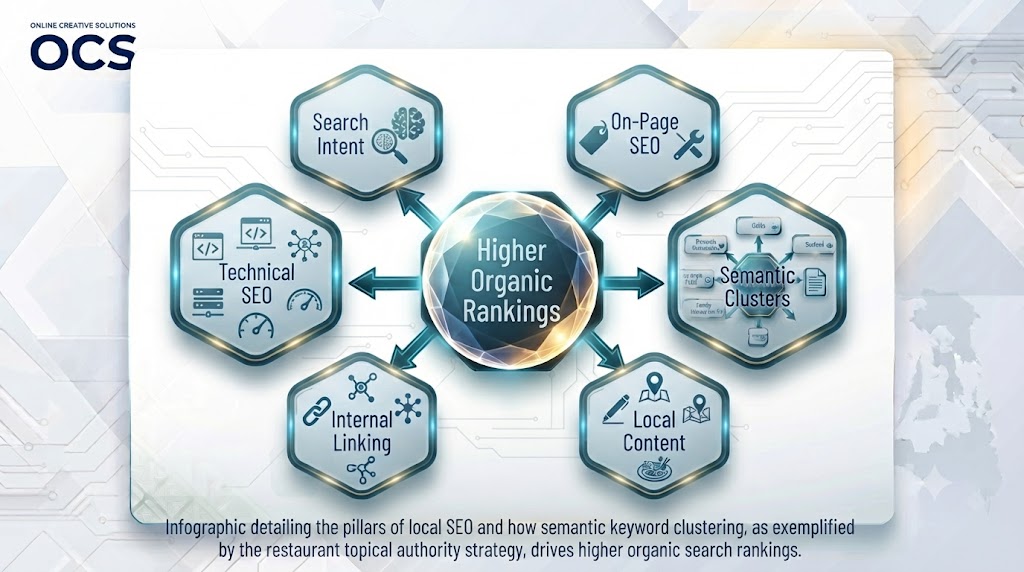
Our SEO strategy focuses on creating content that closely matches what users are actually searching for while ensuring every technical and structural element supports that goal.
That includes:
- Search intent analysis
- Technical SEO
- Content architecture
- Internal linking
- Semantic keyword clustering
- Local optimization
The result is an SEO strategy built for long-term organic visibility—not short-term ranking spikes.
Ready to Improve Your Local Search Rankings?
Whether you’re a local business, tourism website, or regional directory, competing against larger brands is possible with the right strategy.
Online Creative Solutions helps Philippine businesses improve organic visibility through technical SEO, content strategy, and local search optimization.
👉 Book a free discovery call and let’s identify your best keyword opportunities.
Frequently Asked Questions
Can a local website really compete with TripAdvisor?
Yes. While platforms like TripAdvisor have exceptional authority, Google also values relevance. A well-optimized page with strong local signals can rank competitively for geographically focused searches.
What is semantic keyword clustering?
Semantic clustering is the process of organizing related content around a central topic. Instead of optimizing a single page, supporting articles reinforce the authority of the main page and help search engines better understand the site’s expertise.
Does local SEO require paid advertising?
No. The ranking discussed in this case study was achieved through organic SEO techniques, including on-page optimization, content architecture, and local content development.
How long does local SEO take?
Every website is different. Depending on competition, authority, and implementation quality, meaningful improvements often become visible within two to four months.